

AI can now generate more drug candidates than scientists can test. The hard part is proving which ones work in humans, because animal studies and clinical trials move slowly and carry high costs, while lab shortcuts like cell assays often miss how real human tissue behaves. Polyphron trains AI models to manufacture and simulate living human tissue, which gives drug developers a test much closer to a real patient. The New York company grows heart tissue from different donors in an automated lab, exposes it to controlled changes, and tracks how it responds over time. Its simulator learns from that data and predicts how tissue will react to a new treatment, so biotech and pharma teams can check ideas before they reach patients. Cardiac tissue is already in production, liver comes next, and the team plans to grow tissue from more than 20 donors.
AlleyWatch sat down with Polyphron cofounder and CEO Matthew Osman to learn more about the business, its future plans, recent seed round and much, much more…
Who were your investors and how much did you raise?
We raised $20M in seed funding. Quiet Capital led the round, with participation from Haystack, Gradient, and Compound. We would also like to thank our angel investors.
Tell us about the product or service that Polyphron offers.
Polyphron trains frontier AI models to manufacture and simulate living human tissue. We manufacture donor-defined human tissues in our automated foundry, perturb them in controlled ways, measure how they change over time, and use those longitudinal trajectories to train models of tissue behavior.
Cardiac tissue is already in production across multiple donor lines, and we are expanding that donor panel to capture more human biological diversity. Liver is being onboarded next, extending the platform into drug metabolism and liver toxicity, with additional tissues to follow.
Today, this gives biotech and pharma companies a new way to test drug hypotheses and biological predictions directly against living human tissue. But physical verification is only the starting point. Every experiment generates reusable training data for the Polyphron simulator: a predictive model of how human tissues respond to different interventions across time, dose, tissue type, and genetic background.
Our long-term goal is to enable scientists to run the human biology experiment computationally before running it physically: simulating how an intervention is likely to change a tissue trajectory, identifying the most informative experiments to run next, and continuously improving the model with new physical measurements. Ultimately, we want Polyphron to become a simulation environment for human biology, where researchers can explore and optimize interventions across diverse human tissues before moving into patients.
What inspired the start of Polyphron?
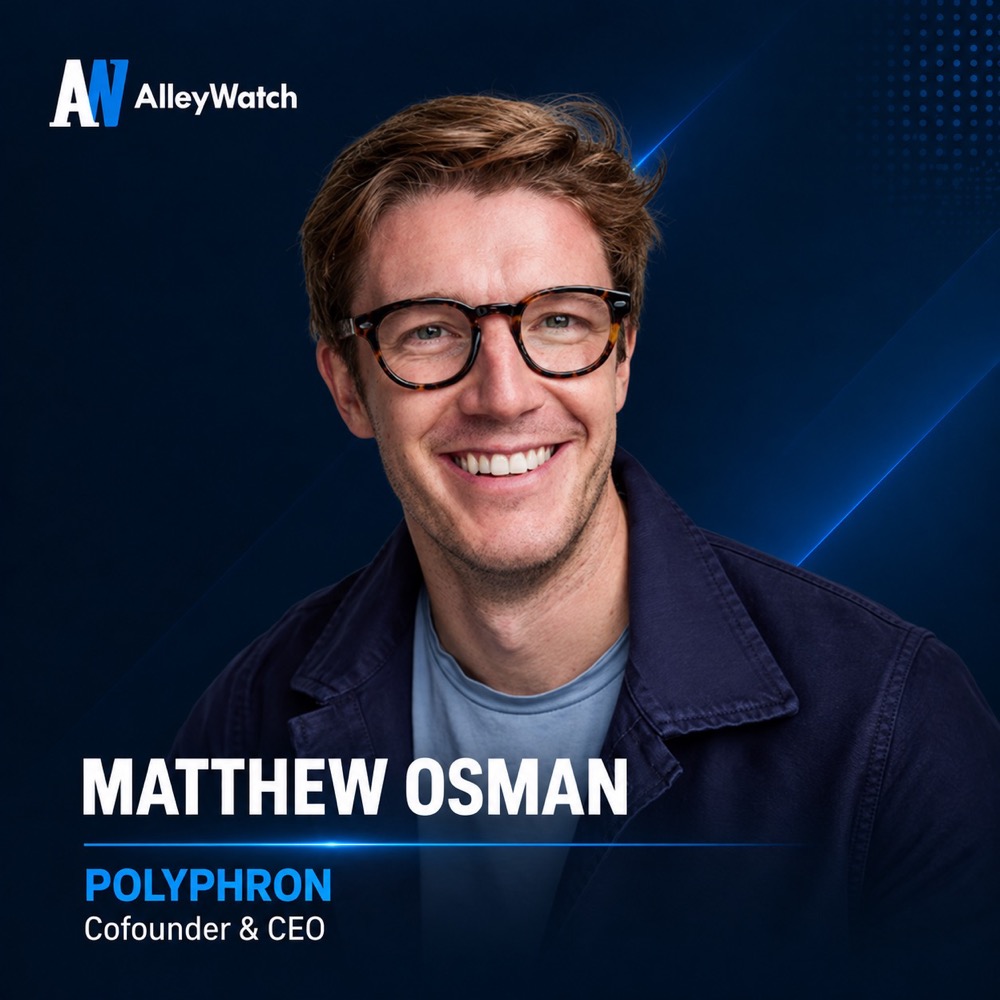 A health scare. In late 2023, an MRI turned up a mass on my pancreas. It turned out to be benign, but the months of not knowing made me think hard about how much of what happens inside the human body are issues that medicine still can’t predict. Our CSO Fabio Boniolo had already spent years on tissue engineering work at Dana-Farber and the Broad Institute, and when we started comparing notes we realized something simple. AI can already generate more drug candidates than anyone can test. What’s missing is a way to accurately test them before they are tested in a human. We believe tissue is the right layer.
How is Polyphron different?
We build the physical and computational systems together. We manufacture the human tissues ourselves, perturb them in controlled ways, and measure how they change over time across genetically distinct donors. In parallel, we train models on those same longitudinal, multi-modal trajectories so the simulator learns not just an average drug response, but how that response changes across tissue type, dose, time, and human genetic background.
Most approaches have only one side of that loop: either models trained largely on existing datasets with limited ability to generate new ground truth, or experimental systems that produce data without turning every experiment into a reusable predictive model. Polyphron combines both in one closed-loop system. That means the platform gets better with every experiment. Each new donor expands human diversity, each new tissue expands the biology the model can represent, and each new perturbation improves the simulator’s ability to predict what will happen next.
Our ambition is not simply to build a better assay or a faster way to validate predictions. We are building a continuously improving simulation environment for human biology, what we call “artificial human biology”.
What market does Polyphron target and how big is it?
Polyphron serves biotech, pharma, and AI labs that need better ways to predict how new interventions will behave in humans. Today, that means testing drug candidates against living human tissue and providing experimental datasets and benchmarks for biological AI models. Our goal is for Polyphron to become a standard simulation and verification layer across drug development (including clinical development), a market ultimately tied to the hundreds of billions of dollars spent globally on biopharma R&D each year.
What’s your business model?
Today, customers access Polyphron through studies that test drug candidates in our human tissues and generate proprietary longitudinal data. As we expand across donors, tissues, and biological contexts, we expect that to evolve into multi-year enterprise relationships that combine access to the Polyphron simulator, proprietary datasets, and reserved experimental capacity. Longer term, some tissues may become therapeutics themselves, creating additional opportunities through internal development or co-development partnerships with milestone and royalty economics.
How are you preparing for a potential economic slowdown?
We raised enough capital in this round to fund the next phase of the platform without needing to return to the market on a compressed timeline. Just as importantly, Polyphron is not structured like a traditional single-asset biotech, where value creation may depend on a single clinical readout years in the future. We are building a platform with multiple commercial applications, which gives us several paths to create value while remaining disciplined about capital.
What was the funding process like?
We are fortunate to attract investors who are comfortable backing ambitious, category-defining companies. What resonated was the idea that Polyphron is not building another biotech platform, but creating a new category around artificial human biology. Our investors bring experience scaling technology companies, building new markets, and helping companies define categories before they fully exist, which has been especially valuable at this stage. They are true rockstars.
What are the biggest challenges that you faced while raising capital?
The hardest part was getting investors past their first instinct, which is to assume the bottleneck in AI and biology is generating ideas. It isn’t. Any pharma company already has a shelf full of hypotheses it hasn’t tested. The bottleneck is testing them in something that actually looks like a human, fast enough and cheaply enough to matter. Once someone gets that distinction, our pitch becomes clearer and easier to understand.
What factors about your business led your investors to write the check?
A lot of it came down to the team already having solved pieces of this problem before, just in different rooms. Fabio ran tissue engineering programs at Dana-Farber and the Broad. Our co-founder and Chief AI Scientist Vinh Q. Tran was a post-training and self-improvement researcher for Gemini at Google DeepMind, and our COO George Pilitsis had scaled a data product at Ginkgo Bioworks from nothing to millions in under two years.
A lot of it came down to the team already having solved pieces of this problem before, just in different rooms. Fabio ran tissue engineering programs at Dana-Farber and the Broad. Our co-founder and Chief AI Scientist Vinh Q. Tran was a post-training and self-improvement researcher for Gemini at Google DeepMind, and our COO George Pilitsis had scaled a data product at Ginkgo Bioworks from nothing to millions in under two years.
What are the milestones you plan to achieve in the next six months?
We are focused on scaling the core infrastructure behind the platform. That means expanding the training dataset across cardiac and liver tissue, building the automation required to run experiments with much greater throughput and consistency, and growing our donor panel to more than 20 lines. Increasing donor diversity is especially important because it allows us to move beyond modeling a single biological response and toward capturing variation across a broader patient population.
What advice can you offer companies in New York that do not have a fresh injection of capital in the bank?
Be ruthless about capital efficiency: get to the next real proof point with as little spend as possible. Hire people who want to build, move fast, and challenge the default way of doing things. Early on, focus and pace are extremely important.
Where do you see the company going now over the near term?
Near term, we’re heads down building our next platform, expanding from cardiac and liver into a broader set of tissues, with enough tissue diversity to start capturing how a drug moves through a whole person rather than just one organ. Past that, we want to become the layer that most new drugs get tested against before anyone runs a clinical trial.
What’s your favorite fall destination in and around the city?
Eating schnitzel at Cafe Sabarsky in the Neue Galerie.