

Fintechs and the banks that sponsor them now operate under a stack of obligations that live in regulations, bank agreements, and internal policies, and no single system connects the three. Compliance teams bridge that gap by hand, reading rule changes, mapping them to policies, chasing evidence across departments, and tracking it all in spreadsheets and email, a burden that pushes growing companies to hire expensive teams early or accept that compliance will slow the business down. Leela builds and runs compliance programs for regulated financial businesses, using AI agents that perform the work instead of tracking it. The platform breaks a program into policies, obligations, tasks, and evidence, and a proprietary language called RegLang links each requirement to the work behind it, so agents know what to do, why, and when to hand a decision to a human. Agents already handle fraud and anti-money laundering reviews, customer complaints, and draft suspicious activity reports for human review, and Leela turned one early customer’s 40 policies into 262 actionable obligations. Smaller fintechs can buy a single self-executing policy and add more as they grow, which gives them the capacity of a compliance team without building one.
AlleyWatch sat down with Leela cofounder and CEO Preeti Krishnan to learn more about the business, its future plans, and recent $4.6M seed round.
Who were your investors and how much did you raise?
Our seed round was raised by co-leads Array Ventures and Female Founders Fund, with participation by Northwestern Mutual Future Ventures, The Council Capital, and Apprentis Ventures.
Tell us about the product or service that Leela offers.
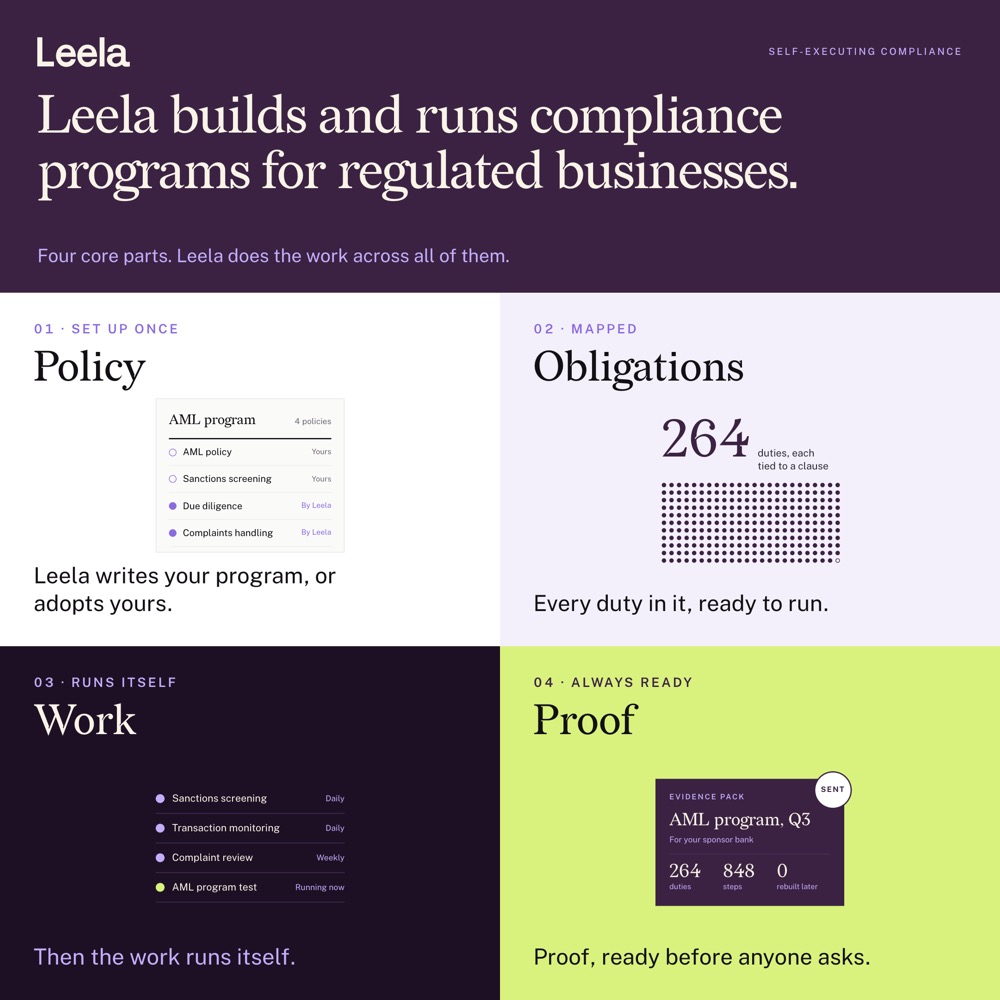
Leela builds and runs compliance programs for regulated financial businesses. We help companies establish their policies, translate those policies into specific obligations, perform the work those obligations require, and maintain the evidence to demonstrate that the work was done.
Underneath the platform is RegLang, our proprietary regulatory language, which connects regulatory requirements and company policies to the actual work happening across a business. This allows our AI agents to understand not just what needs to get done, but why, under what authority, and when human judgment is required.
The idea is simple: most compliance software helps people track the work. Leela actually does it.
What inspired the start of Leela?
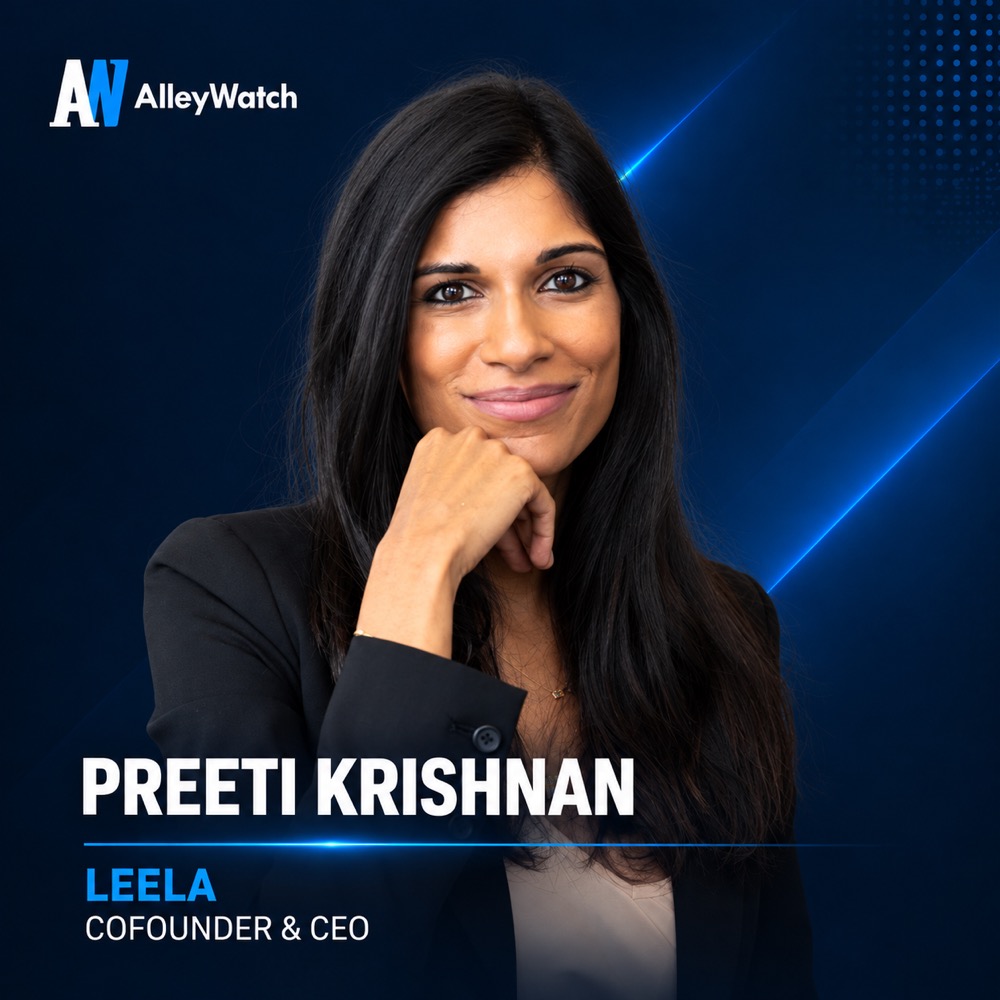 I spent the first part of my career as a corporate attorney at Davis Polk and then moved into senior operating roles at fintech companies, including DailyPay and Kafene. I had the opportunity to see compliance from both sides: first as a lawyer advising financial institutions and then as an operator responsible for helping build and scale regulated businesses.
What struck me was how much of the compliance function still depended on people manually interpreting requirements, coordinating across departments, chasing down information, and documenting what had happened. Even companies with sophisticated technology stacks were managing critical compliance processes through spreadsheets, email, and institutional knowledge.
And because compliance teams were so consumed with keeping up with the work, they often became perceived as a bottleneck to growth.
Frank, my cofounder, and I started Leela because we believed the underlying problem wasn’t a lack of compliance software. It was that the software wasn’t actually doing the work (and certainly not doing anything where people were actually working). With advances in AI, we saw an opportunity to fundamentally change that.
How is Leela different?
Most compliance technology is designed around visibility: dashboards, alerts, task lists, and systems of record. These tools can tell you what needs attention, but they generally leave the execution to a person.
Leela is built around execution.
We break compliance down into its component parts: the policies governing a business, the obligations those policies create, the work required to satisfy those obligations, and the evidence that demonstrates completion. Our AI agents can then perform multi-step compliance workflows across the systems a company already uses.
Just as importantly, Leela is designed for regulated environments. Our agents operate within defined rules, maintain an auditable record of their actions, and involve humans when judgment or approval is required.
We’re not trying to build a better compliance checklist. We’re building an automated compliance workforce.
What market does Leela target and how big is it?
We’re initially focused on regulated financial businesses, particularly fintech companies, payments businesses, lenders, insurers, and other financial services companies navigating increasingly complex regulatory and contractual requirements. Our early customers are often growing businesses that need sophisticated compliance capabilities but don’t necessarily have the resources to build large internal compliance departments.
The opportunity is significant. Financial institutions collectively spend billions of dollars annually on compliance, much of it on labor-intensive processes that have historically been difficult to automate.
We believe the broader opportunity extends well beyond financial services. Every regulated industry has some version of the same problem: complex requirements that must be translated into operational work, continuously executed, and documented. Financial services is where we’re starting.
What’s your business model?
Leela runs on a monthly fee model priced based on the work we do within your compliance program.
Our goal is to make sophisticated compliance capabilities accessible to companies that historically would have needed to assemble a much larger internal team or rely heavily on external consultants.
We’ve also built a self-service experience so companies can begin using Leela directly at a lower cost and expand their programs as their needs evolve. Companies can simply purchase a single self-executing policy and then stack more as they grow.
How are you preparing for a potential economic slowdown?
One advantage of building in compliance is that the underlying need doesn’t disappear when the economy slows. Regulatory obligations still exist, examinations still happen, and companies still need to demonstrate that they’re operating responsibly. But budgets become more constrained, and businesses become much more thoughtful about headcount and software spending.
We think that creates an opportunity for Leela. Rather than adding another software subscription that requires employees to manage it, we’re offering a way to get essential work done with significantly less manual effort.
Internally, we’re being disciplined about hiring and spending, staying close to our customers, and prioritizing product capabilities that deliver measurable value.
What was the funding process like?
Fundraising was an exercise in finding investors who shared our conviction about where enterprise AI is heading. There’s enormous excitement around AI, but also a lot of noise. We spent considerable time explaining why we believe the next generation of enterprise software won’t simply help employees find information or manage tasks. It will actually perform work on their behalf.
That thesis becomes particularly interesting in regulated industries, where the work is complex, consequential, and subject to very specific rules.
We were fortunate to find investors who understood both the scale of the opportunity and the importance of building this technology thoughtfully. Array Ventures and Female Founders Fund, in particular, recognized that compliance could be a compelling entry point for a much broader category of AI-driven trust infrastructure.
What are the biggest challenges that you faced while raising capital?
One challenge was helping investors distinguish between traditional compliance software and what we’re actually building.
Compliance technology has historically been a category focused on monitoring, recordkeeping, and workflow management. We’re proposing a fundamentally different model in which software performs the underlying work.
That requires investors to think differently about the market, the competitive landscape, and even how the product should be valued.
The other challenge was balancing the ambition of the vision with the practical realities of building AI for regulated businesses. You can’t simply deploy autonomous agents into high-stakes workflows and hope for the best. The technology needs appropriate controls, clear authorization, human oversight, and a reliable record of what happened.
We had to demonstrate that we understood both the opportunity and the responsibility that comes with it.
What factors about your business led your investors to write the check?
I think it was a combination of founder-market fit, the size of the problem, and our approach to solving it.
I had spent years working inside the exact environments we’re building for, so we weren’t approaching compliance as an abstract software problem. We understood the operational complexity, the regulatory stakes, and the limitations of existing tools.
Frank brought the technical expertise to rethink how the work could actually be performed.
And I think our investors recognized that the shift from AI that generates information to AI that takes action represents an enormous opportunity, particularly in industries where the work is governed by complex rules.
What are the milestones you plan to achieve in the next six months?
Our biggest priority is turning the technology we’ve built into something that customers can adopt quickly and use to run meaningful portions of their compliance programs.
We’ve just launched our self-service product, which allows businesses to experience Leela directly by buying and stacking policies. Over the next six months, we’re focused on expanding the range of workflows we can execute and sitting deeper within companies’ system stacks in order to offer our customers the most flexible and simple experience of “native compliance” possible.
We’re also focused on growing our customer base and demonstrating that Leela can deliver measurable improvements in the cost, speed, and quality of compliance execution.
Ultimately, success means that more of our customers’ compliance work is getting done automatically, with appropriate oversight and a clear record of every action.
What advice can you offer companies in New York that do not have a fresh injection of capital in the bank?
Stay very close to your customers and be ruthless about identifying what they actually value.
Especially in an environment where technology is changing so quickly, it’s easy to get distracted by what you could build rather than what someone urgently needs you to solve.
I’d also encourage founders to make use of the incredible density of expertise and relationships in New York. Some of our most valuable conversations have come from people who weren’t prospective investors or customers, but who understood the industry deeply and were willing to challenge our assumptions.
Capital is helpful, but clarity about the problem you’re solving and the customer you’re solving it for is even more valuable.
Where do you see the company going now over the near term?
We’re focused on making Leela the default way that growing regulated financial businesses build and operate their compliance programs.
Historically, a company entering a regulated market had to assemble some combination of lawyers, compliance professionals, consultants, and software tools to manage its obligations. We think that model is going to change dramatically.
Our vision is that a company can establish its compliance program with Leela and have the platform continuously execute much of the work required to maintain it, escalating to humans when necessary.
Over time, we believe this approach can extend across many other regulated industries.
What’s your favorite fall destination in and around the city?
Prospect Park. I live in Carroll Gardens with my husband and our two young boys, and there’s really nothing better than spending a fall afternoon in the park. The changing leaves, the playgrounds, the farmers markets, and the general energy of Brooklyn in the fall are hard to beat. It’s one of my favorite things about raising a family in New York.