


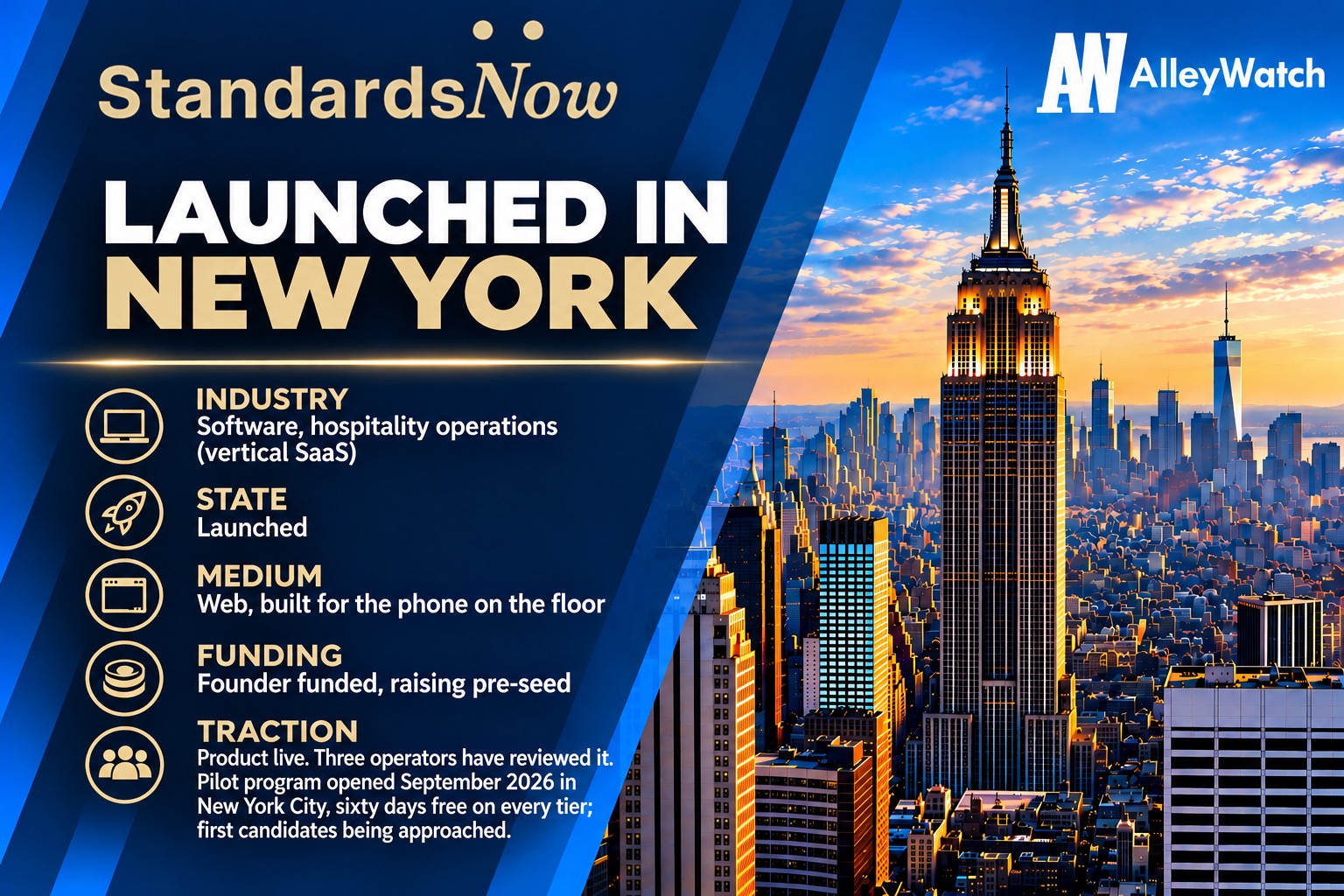
Hospitality runs on small observations, like a cooler running warm, a regular who complained twice, or a blocked exit during a rush, and most of them never leave the head of the person who noticed. Accommodation and food services lose roughly two-thirds of their workforce every year, according to Bureau of Labor Statistics data, and immigrants made up more than 60% of New York City restaurant workers in 2018, according to the New York State Comptroller, so that knowledge rarely stays in one place or one language. StandardsNow closes the gap with bilingual operations software that lets anyone on the floor log a problem in two taps, by photo, voice note, or text, in English or Spanish. Each log lands with an owner and a deadline, and every resolved issue builds a memory of the venue that flags repeat problems, so managers spot patterns before they become surprises. The software never passes a verdict on a named person and routes tasks rather than people, a deliberate choice meant to make reporting feel safe for the workers closest to the problem. The company’s founder spent 26 years in hospitality before building it, and the product is now live, with a pilot program that opened in September 2026 and offers 60 days free on every tier.
AlleyWatch sat down with StandardsNow Founder and CEO Shaun R. Jenkins to learn more about the business, why he built it in New York, how the pilot program will shape its first paying venues, and much, much more…
Tell us about the product or service that StandardsNow offers.
StandardsNow is hospitality operations software, the software a venue runs on every shift. Anyone on the floor logs what they see in two taps, with photo, voice or text, and it is logged with an owner and a deadline before the problem walks away, in English or Spanish, whichever is theirs. The manager sees the venue on one screen: venue health the second you look, open issues, checklists, huddle and shift reports, emergency and security, and a cost center that shows money kept and money at risk. Every resolved issue becomes part of the venue’s memory, so repeats are flagged and the loop gets tighter every shift. It is built on three design laws: no verdict on a named person, ever; a signal stays open until it is resolved; routing names the task, never the person. The product is live.
What inspired the start of StandardsNow?
 After spending twenty-six years in the hospitality industry, I realized that I only had sixty percent of the knowledge to perform my job successfully. The remaining forty percent of information lived in someone’s mind, a clipboard, a group chat, or siloed. Sadly, it was that invisible forty percent that ultimately hurt me in the past, and continues to put hospitality and service industry companies out of business. After experiencing these real work and life situations, it was simple for me to see the gap in the market, conceptualize it, and bring StandardsNow to life. The idea came to me in business school. It came to life after a glass of wine and a conversation with my wife.
How is it different?
Most systems on the market show a piece of the day. StandardsNow shows the whole loop, from what a worker saw to what the owner learned: see it, capture it, resolve it, compound it. It does not grade people; it shows the forty percent of the work nobody sees, and the worker owns their own record and can export it, with no performance score on anyone. It is bilingual by birth, English and Spanish as a native second voice rather than a translation layer, because that is who actually runs a New York floor. And it was built by an operator with twenty six years on the floor and in the P&L, not by a software company guessing at what a shift looks like.
What market does StandardsNow target and how big is it?
Hospitality operations first: hotels, bars and restaurants, then fitness and senior living, which run on the same shift and checklist pattern. The launch market is New York City, one venue at a time, by introduction. On record, the New York City metro market is 35,781 venues and a $153.9M annual addressable market, and the ratified addressable market across all served markets is $552.97M. Beyond that sit convenience stores, casinos, golf and country clubs and staffed buildings, every place where a shift happens and the floor knows first.
What is the business model?
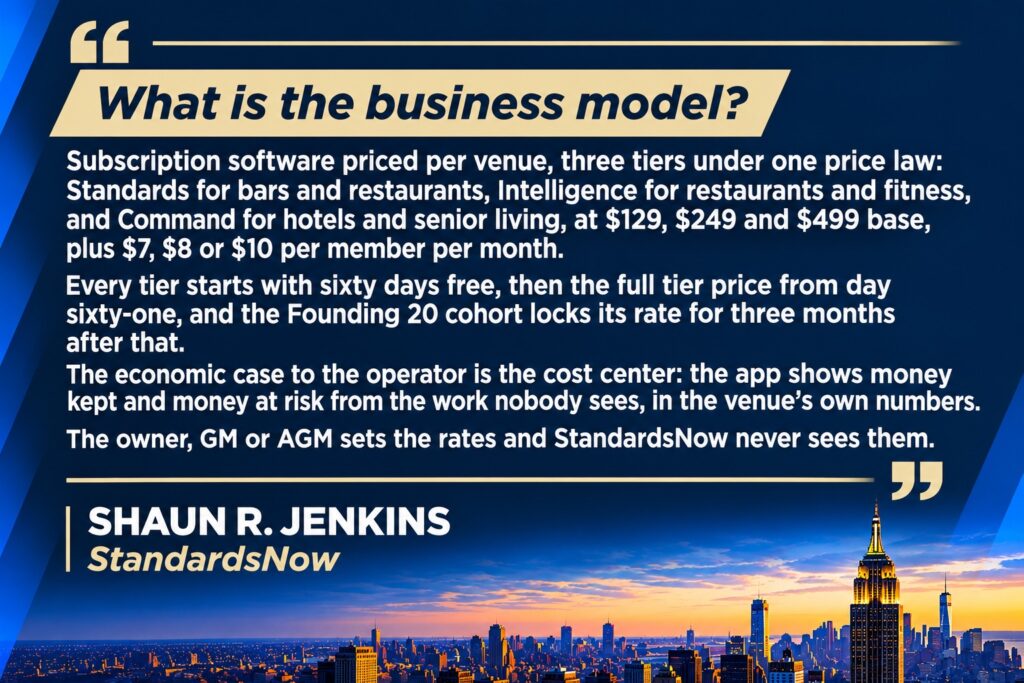
Subscription software priced per venue, three tiers under one price law: Standards for bars and restaurants, Intelligence for restaurants and fitness, and Command for hotels and senior living, at $129, $249 and $499 base, plus $7, $8 or $10 per member per month. Every tier starts with sixty days free, then the full tier price from day sixty-one, and the Founding 20 cohort locks its rate for three months after that. The economic case to the operator is the cost center: the app shows money kept and money at risk from the work nobody sees, in the venue’s own numbers. The owner, GM or AGM sets the rates and StandardsNow never sees them.
How are you preparing for a potential economic slowdown?
Hospitality is the first industry to feel a slowdown and the last to recover, so the product was designed for an operator who is watching every dollar. The cost center puts a number on the work nobody sees, which is the first place a tight operator looks for waste. The company itself was built lean: one founder, start to finish in seven months, with a verified build record, so the burn is small and a pre seed round funds engineering and sales rather than overhead. Sixty days free on every tier means a venue proves the value before it pays. The founding cohort pricing rewards the operators who commit early, in any economy.
What are the milestones that you plan to achieve within six months?
First ten paying venues, the founding cohort, out of the New York City pilot program that opened in September. The first hire after the pre seed close, an engineering lead. The first property management system integration, built with a design partner. An independent penetration test and SOC 2 readiness, so a multi property brand can buy. And retention proof from the founding cohort, the number that matters more than any logo.
What is the one piece of startup advice that you never got?
You do not need an engineer to start. You need the problem and the discipline to log every build. I spent years assuming the product had to wait for a technical cofounder, and it did not. I built StandardsNow solo in seven months with ChatGPT and Claude as the engineering team, and I logged every build, every edit and every audit so the record can be verified by anyone who asks. Nobody told me that was possible, and nobody told me the record would matter as much as the product.
If you could be put in touch with anyone in the New York community who would it be and why?
Danny Meyer. Union Square Hospitality Group taught a generation of New York operators that standards and culture are the business, not a department of it. “Standards, kept” was the founding idea of StandardsNow before the company existed. I would want his read on one line we drew: a tool can hold a standard across a floor without ever grading the person holding it. He has lived that question at scale, and I have lived it from the floor.
Why did you launch in New York?
I am a Brooklyn native and I have run New York floors for twenty-six years, so this is the only place I could have built it. New York hospitality is the hardest version of the problem: the most venues, the highest labor cost, the most languages on one shift and the least patience for a work surprise. If the loop holds here, it holds anywhere. And this city runs on introduction, which is how the launch works: one venue at a time, by introduction, the way New York operators actually buy.
What’s your favorite fall destination in and around the city?
The Hudson Valley. I drive north for the foliage, and a day out of the city with nothing to log is the reset.