
Small and mid-sized companies make up most of the physical economy: 99.3% of US motor carriers run fewer than 100 trucks, and 93% of US manufacturers employ fewer than 100 people. Their most valuable asset is the judgment of employees with 20 years on the job, and software that only records what already happened captures almost none of it, so that knowledge leaves when those veterans retire. Evos builds autonomous operators that learn a job from a company’s most experienced people, prove they can match those people’s decisions, and then do the work inside the TMS, WMS, ERP or shared inbox the business already runs. Each operator starts in shadow mode, takes over a function only after its decisions consistently match the team’s, and gives the business control over how much autonomy to grant. One freight brokerage uses an Evos operator to audit every LTL carrier invoice against its TMS, and the operator made nearly 3,500 audit decisions at 97% accuracy in two months and closed out more than $600K of invoice value in the last five weeks alone. Evos passed $1M in ARR four weeks after its first deployments, and every customer has added operators beyond its first.
AlleyWatch sat down with Evos Founder and CEO Urav Shah to learn more about the business, its future plans, recent funding round, and much, much more…
Who were your investors and how much did you raise?
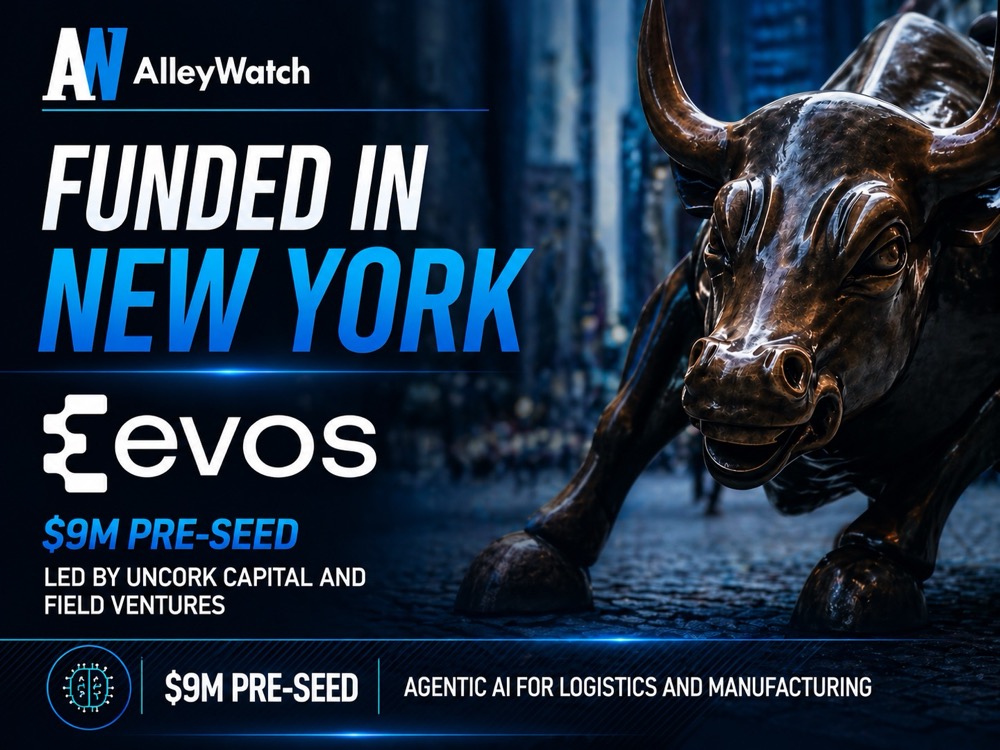
We raised $9M in pre-seed funding. The round was co-led by Uncork Capital and Field Ventures, with participation from Crosslink Capital, Utopia Capital Management, Sandwith Ventures, and a group of angel investors.
Tell us about the product or service that Evos offers.
Evos builds autonomous operators for the businesses that make, move and power the economy: freight brokers, carriers, 3PLs and manufacturers. An operator learns a job from a company’s most experienced people, proves it can match their decisions, and then does the work itself inside the systems the business already runs, whether that is a TMS, a WMS, an ERP or a shared inbox. It replaces nothing and sits on top of what is already there.
For a freight brokerage, that means operators that audit carrier invoices, track loads, handle check calls and work exceptions. For a carrier, it is broker communication, dispatch support, status updates and billing. For a 3PL, it is order and shipment exceptions, customer updates and inventory reconciliation. For a manufacturer, it is production scheduling, supplier follow-ups, quality non-conformance and the procurement paperwork that eats a planner’s week. In every case the operator learns the job from the person who does it today, starts in shadow mode, and only runs on its own once its decisions consistently match the team’s.
The difference from most AI tools is that an operator is given a function, not a prompt. Nobody has to ask it, review it and act on every answer. One freight brokerage has an operator auditing every LTL carrier invoice against its TMS: nearly 3,500 audit decisions at 97% accuracy in its first two months, and more than $600,000 of invoice value closed out in the last five weeks alone.
What inspired the start of Evos?
 The story is partly my own. My family ran a manufacturing business in Nairobi for decades, and I spent much of my childhood on factory floors. I went into tech early, started my first company at 18, and by 23 had founded four and exited two, across generative world models, quantum computing and modular data centers.
After my last exit I went home and started consulting for businesses like my family’s: small and mid-sized companies in the physical economy. What struck me was how little had been built for them. Their software was a system of record that logged what had already happened, while the real work happened outside it, with people. Anything better cost hundreds of thousands of dollars and months to implement. And the most capable system in most of these businesses was the person who had been there 20 years, whose knowledge had never been written down and who was about to retire. Evos is the product I wished those businesses had.
How is Evos different?
Three things. First, how it gets live. Where a consultancy would spend 9 to 18 months mapping workflows, the discovery with Evos is a conversation between the team and an agent. We call it the Trifecta: one hour with a company’s experts, a working operator the next day, measurable results within a month.
Second, what it delivers. Most AI tools need constant prompting, so the team ends up managing inputs. An Evos operator takes on a function and is judged on outcomes. It learns from the decisions the team actually makes rather than from an instruction manual, and the business decides how far to take it, from a person signing off on every step to the operator running entirely on its own.
Third, who it is built for. Nearly every well-funded entrant in this space is chasing the hundred largest companies in each industry. We built something that works for a 50-person brokerage or a third-generation machine shop, fits into the operation with almost no change management, and is designed to pay for itself in weeks.
What market does Evos target and how big is it?
Small and mid-sized businesses in physical industries. In the US, 99.3% of motor carriers run fewer than 100 trucks and 93% of manufacturers have fewer than 100 employees. By count they are nearly the entire industry, and almost nothing has been built for them.
The spend they sit on is enormous. US business logistics costs alone were $2.4 trillion in 2025, about 7.8% of GDP. We started in logistics, with freight brokers, carriers and 3PLs, and the platform is horizontal by design: manufacturing, e-commerce, food and beverage and retail follow as the platform launches.
What’s your business model?
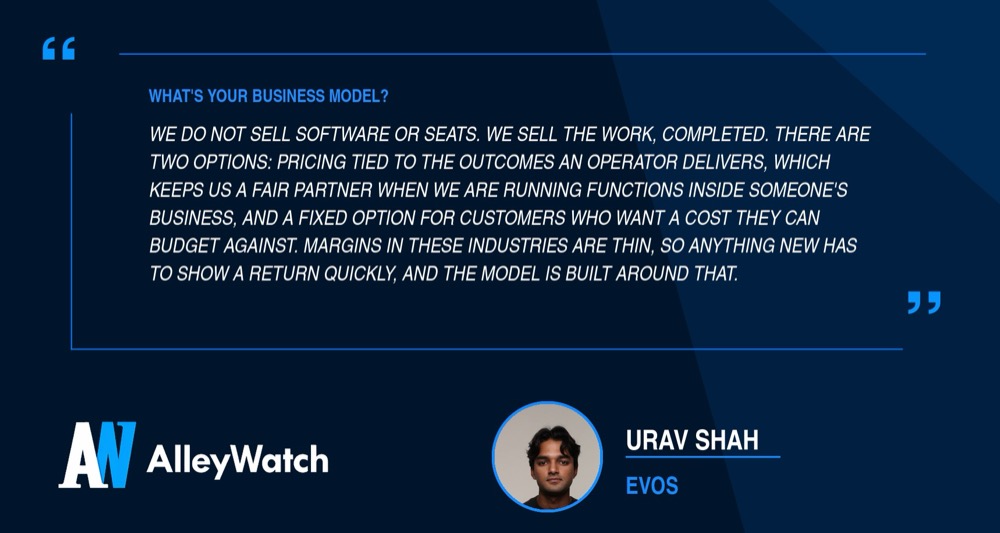
We do not sell software or seats. We sell the work, completed. There are two options: pricing tied to the outcomes an operator delivers, which keeps us a fair partner when we are running functions inside someone’s business, and a fixed option for customers who want a cost they can budget against. Margins in these industries are thin, so anything new has to show a return quickly, and the model is built around that.
How are you preparing for a potential economic slowdown?
The businesses we serve have always operated as if a slowdown is coming. Margins are thin, there is no IT team and no appetite for a twelve-month implementation, so we built the product to pay for itself in weeks and priced it against the outcomes it delivers. When volumes soften and teams cannot hire, the need to get more done with the people you already have goes up, not down.
On our side, we passed $1M in ARR within four weeks of our first deployments, every customer has added operators beyond their first, and nobody has churned. We are growing the team deliberately rather than quickly, and the round gives us a long runway to do that.
What was the funding process like?
Fast, and led by the customers more than by us. By the time we were in conversations with investors, operators were already live and the results were visible, so most of the diligence was investors talking to the people running Evos on their own ops floors. Uncork and Field both moved quickly, and the rest of the round came together around them.
What are the biggest challenges that you faced while raising capital?
The hardest part was the market, not the product. Investors are trained to look at the top of each industry, so the first job was showing that a 50-person trucking company is not a niche, it is most of the physical economy, and that it will pay for work that actually gets done. The second was credibility: I am 23 and selling into businesses that have been handed down through three generations. The deployments did that arguing for us.
What factors about your business led your investors to write the check?
Proof that the work was getting done. Operators live inside real businesses, measurable results in weeks, $1M in ARR four weeks after our first deployments, and customers expanding rather than churning. Our investors put it better than I can: Tripp Jones at Uncork said what stood out was how quickly teams were putting operators to work on core parts of their business without a long technology roll-out, and Richard Kerby at Field said that for decades software sold to industrial businesses has helped people track work but stopped short of doing it. That gap, and the speed at which we were closing it, is what they backed.
What are the milestones you plan to achieve in the next six months?
Launching Workhorse, our platform, in the coming weeks. Growing the team to around 16 by the end of the year, with most of those hires in New York. Taking operators beyond logistics into manufacturing and the other sectors we built the platform for. And building partner offerings with the private equity firms and consultancies that already work with these businesses every day.
Launching Workhorse, our platform, in the coming weeks. Growing the team to around 16 by the end of the year, with most of those hires in New York. Taking operators beyond logistics into manufacturing and the other sectors we built the platform for. And building partner offerings with the private equity firms and consultancies that already work with these businesses every day.
What advice can you offer companies in New York that do not have a fresh injection of capital in the bank?
Sell the outcome and get to revenue. The businesses that will pay you are the ones that do not care about your tech, they care that the work gets done. If you can show that in weeks rather than quarters, customers will fund you before investors do, and the conversations with investors get a lot shorter. The other piece is to pick a market the rest of the industry is ignoring. There is far less competition for customers’ attention in the physical economy than in software.
Where do you see the company going now over the near term?
Launch week first. Then Workhorse, our platform launch. We are at Broker Carrier Summit in Dallas and FreightWaves F3 in Chattanooga at the end of October, we have just moved into a new office in West Chelsea, and we are hiring. The near-term goal is simple: more operators running more functions for more brokers, carriers, 3PLs and manufacturers, and every one of them proving it can match the best person on the team.
What’s your favorite fall destination in and around the city?
Pete’s Pies.