

Healthcare’s payment landscape has become an arms race between payers and providers, and providers are losing. While insurers deploy sophisticated AI to automate claim denials and reduce reimbursements, hospitals and health systems manage an increasingly complex revenue cycle with legacy systems and overburdened staff. Recent policy shifts, including the One Big Beautiful Bill’s reshaping of Medicaid and ACA subsidies, have intensified this imbalance by increasing the uninsured population and adding layers of reimbursement complexity just as denial rates climb. Traditional revenue cycle management processes now cost providers up to 15% or more of their potential revenue in inefficiencies, creating a structural crisis where the technology gap directly translates to financial hemorrhaging. Adonis addresses this fundamental imbalance with an AI orchestration platform that learns from tens of millions of claims monthly to proactively identify vulnerabilities before they become revenue losses, recommend precise actions, and autonomously deploy resolutions. The company achieved more than 4x revenue growth in 2025 with net retention above 130%, metrics that reflect genuine operational impact rather than theoretical promises, with health systems like Mount Sinai using the platform to reimagine how revenue cycle operations are executed.
AlleyWatch sat down with Adonis Cofounder and CEO Akash Magoon to learn more about the business, the founder’s journey from building tech for insurers to leveling the playing field for providers, recent strategic developments, recent funding round, and much, much more…
Who were your investors and how much did you raise?
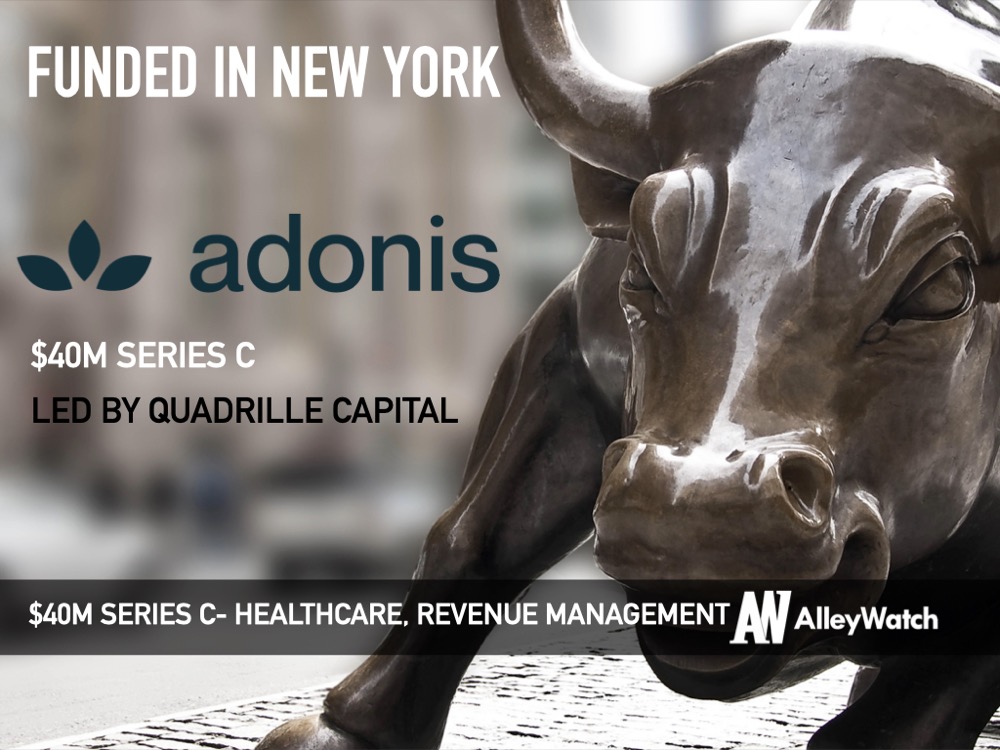
Adonis raised $40M in a Series C funding round led by Quadrille Capital, with continued participation from existing investors General Catalyst and Bling Capital. The round brings our total funding to over $95M since the company’s founding in 2022.
Tell us about the product or service that Adonis offers.
Adonis is the leading AI orchestration platform for revenue cycle management (RCM), purpose-built for healthcare organizations seeking to transform their revenue operations. Traditional RCM processes often struggle with inefficiencies, costing providers up to 15% or more of their potential revenue. Adonis addresses these challenges through a combination of Intelligence and AI Agent products that proactively monitor and detect revenue cycle issues, recommend tailored actions, and autonomously progress claims to resolution. Whether identifying problems before they escalate, recommending tailored resolutions, or automating deployment, Adonis creates a seamless, future-proofed approach to RCM, empowering teams to act faster, smarter, and more autonomously than ever.
What inspired the start of Adonis?
 Before founding Adonis, my brother Aman and I cofounded a company backed by major health insurers, which gave me a firsthand look at how payers deploy technology to automate claim denials and reduce reimbursements to hospitals. I saw the structural imbalance this created, insurers had sophisticated tools, while providers were left managing an increasingly complex payment landscape with legacy systems and overburdened staff. Adonis was built to level the playing field. Health systems deserve the same AI-driven capabilities that payers have used for years, and we’re determined to give it to them.
How is Adonis different?
Most RCM tools are reactive, helping teams manage denials after they happen. Adonis is fundamentally proactive. Our AI learns from tens of millions of claims on a monthly basis across our customers to identify vulnerabilities before they become revenue losses, recommends precise actions, and deploys resolutions autonomously. Critically, we’re built with a human-in-the-loop design that gives CFOs and CIOs the governance and accountability they need to adopt AI with confidence. We’re not replacing RCM teams, we’re making them dramatically more effective. The results speak for themselves: customers like Mount Sinai Health System have reimagined how revenue cycle operations are executed using our platform.
What market does Adonis target and how big is it?
Adonis serves hospitals, health systems, and provider groups. The U.S. healthcare revenue cycle management market is massive. The structural pressures driving demand are only growing: rising denial rates, workforce shortages, and policy shifts like the One Big Beautiful Bill, which has reshaped Medicaid and ACA subsidies and added new complexity to reimbursement requirements.
What’s your business model?
Our model is enterprise contracts with hospitals, health systems and provider groups. We structure those agreements around clearly defined value and defensible ROI, so the economic upside for our customers significantly outweighs the cost of the investment. In practice, that means we align to outcomes like accelerated cash, reduced denials, and lower cost to collect, and we price in a way that lets customers see a straightforward, positive return without having to take on a lot of risk or complexity in how they buy. We price based on each customer’s claim volume and the estimated number of agentic actions we expect to take on their behalf, so they’re investing in the automation they actually need.
How are you preparing for a potential economic slowdown?
Healthcare revenue cycle is a non-discretionary function, providers have to get paid regardless of macroeconomic conditions, which makes RCM one of the more resilient categories in health tech. If anything, an economic slowdown increases the pressure on health systems to collect more efficiently and reduce operational costs, which is exactly the problem Adonis solves. Our 130%+ net revenue retention reflects the stickiness of this value proposition: customers expand with us as they see results. We’re focused on deepening those relationships and continuing to deliver measurable ROI for our customers.
What was the funding process like?
We were lucky enough to get pre-empted by our new investors in this round. They came to us before we officially kicked off a process and they got caught up to speed pretty quickly before giving us an offer.
What are the biggest challenges that you faced while raising capital?
There is a lot of noise in the AI market right now, especially in revenue cycle. There has also been a number of companies in our space that have failed in the past. That created a bigger burden on us to show investors how we are uniquely solving customer challenges and how we separate ourselves from others.
What factors about your business led your investors to write the check?
A few things stood out. First, our growth metrics: Adonis achieved more than 4x revenue growth in 2025 with net retention above 130%, numbers that reflect genuine customer value, not just expansion. Second, the quality of our customer base, including health systems like Mount Sinai. Third, the macro tailwind: as denial rates rise and RCM complexity grows, the need for AI-driven solutions is only accelerating. As Amine Baji, Partner at Quadrille Capital, put it, revenue cycle performance has become a mission-critical driver of financial stability and Adonis is uniquely positioned to tackle the most complex workflows end-to-end.
A few things stood out. First, our growth metrics: Adonis achieved more than 4x revenue growth in 2025 with net retention above 130%, numbers that reflect genuine customer value, not just expansion. Second, the quality of our customer base, including health systems like Mount Sinai. Third, the macro tailwind: as denial rates rise and RCM complexity grows, the need for AI-driven solutions is only accelerating. As Amine Baji, Partner at Quadrille Capital, put it, revenue cycle performance has become a mission-critical driver of financial stability and Adonis is uniquely positioned to tackle the most complex workflows end-to-end.
What are the milestones you plan to achieve in the next six months?
Over the next six months, our focus is on scaling both product adoption and operational impact across our customer base. Specifically, we’re aiming to:
- Deepen product capabilities by expanding automation and intelligence across the revenue cycle, enabling customers to reduce manual work and improve accuracy at scale.
- Accelerate customer growth and expansion, both by onboarding new enterprise health systems and growing within existing partners.
- Continue demonstrating real ROI and value for our customers, with clear improvements in collections, denial reduction, and operational efficiency.
- Strengthen our data advantage, leveraging our growing dataset to deliver better insights and continuously improve performance.
- Build out our team, particularly across engineering, product, and go-to-market, to support the next phase of growth.
Ultimately, the milestone we care most about is becoming a system of record for revenue cycle operations, delivering consistent, quantifiable financial outcomes for healthcare providers.
What advice can you offer companies in New York that do not have a fresh injection of capital in the bank?
For companies in New York without fresh capital and especially those not yet profitable, the key is shifting from “default alive by funding” to “default alive by design.”
First, focus on what truly drives revenue. In tighter environments, you can’t afford broad experimentation everywhere. Double down on the parts of the business that are clearly working and cut or pause what isn’t.
Second, manage burn with intention, not fear. The goal isn’t to shrink the company. It’s to buy enough time to hit the next set of meaningful milestones that make the business fundable or sustainable.
Third, prioritize products that customers can’t turn off. If you’re solving a painful, high-ROI problem, customers will stick with you even in budget-constrained environments.
And finally, be transparent with your team, your customers, and yourself. Companies that acknowledge where they are and execute with discipline tend to navigate these periods much better than those trying to maintain a growth-at-all-costs mindset.
Where do you see the company going now over the near term?
With this Series C, Adonis will accelerate product innovation across our Intelligence, AI Agents, and Orchestration platform, deepen our presence in the health system market, and continue expanding our NYC–based team. The payer-provider AI arms race is just getting started, we’re building the infrastructure that health systems need to compete and win.
What’s your favorite spring destination in and around the city?
In the city, during the spring, nothing beats playing pickup basketball at one of the public courts. Our office is in 3 World Trade Center, so going to the courts in Battery Park is always fun.
Around the city, a good weekend trip to the Hamptons will never get old.