


Labor shortages and rising costs have squeezed independent liquor store owners from every side, yet they still spend hours each week keying distributor invoices into outdated systems. Each state sets its own rules for taxes, deposits, and shipping, and a single store can carry thousands of SKUs, from vintage wine to returnable kegs, which generic point-of-sale software built for restaurants and general retail never anticipated. Santé gives these stores one operating system built for the category, with checkout, e-commerce, delivery app orders, marketing, and subscriptions in a single platform. AI agents work on top of that data: they scan distributor invoices, suggest prices for slow-moving inventory, write SEO-optimized product listings, and segment customers for email and SMS campaigns, so owners spend less time on data entry and more time selling. The New York company now powers nearly 1,000 retail locations that process more than $2B in annual gross merchandise volume, and its business grew 500% in the past year. Santé also earns revenue from payment processing and accounts payable tools built into the platform, so its income rises with the sales of the stores it serves.
AlleyWatch sat down with Santé Founder and CEO Darren Fike to learn more about the business, its future plans, recent funding round that brings the company’s total funding raised to $22.6M, and much, much more…
Who were your investors and how much did you raise?
We raised a $15M Series A round led by FINTOP alongside returning investors Bonfire Ventures, Operator Collective, Veridical Ventures, and TipTop VC.
Tell us about the product or service that Santé offers.
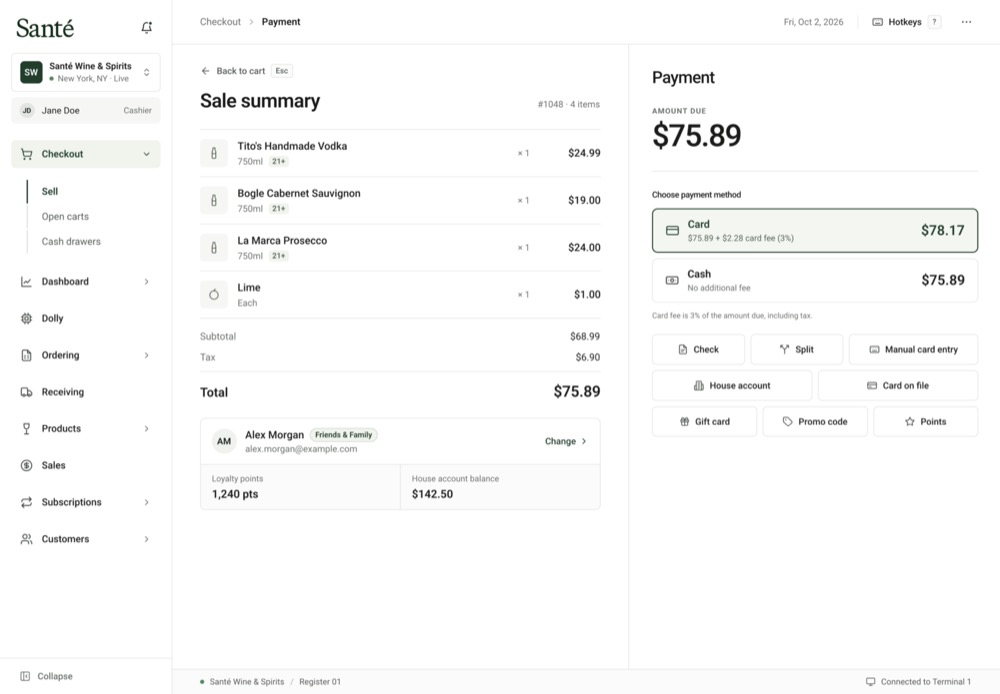
Santé is a complete, AI-powered operating system and point-of-sale (POS) platform built specifically for wine and spirits retailers. It consolidates a store’s entire operation, in-store checkout, e-commerce, third-party delivery apps (like DoorDash and UberEats), marketing, and subscriptions, subscriptions and into one place.
The platform’s standout feature is its suite of autonomous AI Agents that actively manage back-office work. These include an AI Merchandising Agent to optimize pricing on slow-moving inventory, an AI Receiving Agent that scans distributor invoices to update costs instantly, and automated tools that generate SEO-optimized images and descriptions for e-commerce catalogs
What inspired the start of Santé?
 I noticed that my favorite wine shops in NYC were running on legacy systems that held them back. After 100+ conversations with retailers across the country, I took a part-time job at a wine store in TriBeCa to learn the industry.
Since founding Santé, we’ve learned the structural challenges that independent wine & liquor stores face, including state-by-state regulatory compliance, massive SKU proliferation, and complex distributor invoicing. We set out to build a platform that eliminated these operational headaches, freeing owners from manual data entry so they could focus on driving revenue.
How is Santé different?
While most liquor stores rely on legacy systems or generic POS software adapted from restaurants, Santé is vertically integrated with liquor-specific logic. It natively handles industry nuances like vintage management, keg tracking, and complex mix-and-match case discounts. We built Santé to shift software from being a passive tracking tool to an active participant. Instead of just logging inventory, Santé’s AI Agents proactively suggest pricing strategies, sync e-commerce descriptions, and use historical transaction data to segment customers for targeted marketing campaigns.
What market does Santé target and how big is it?
Santé targets the independent beer, wine, and liquor store industry. In the United States alone, this market encompasses approximately 34,000 retail establishments. The total U.S. beer, wine, and liquor retailing market size is estimated to reach $87.2 billion in 2026.
What’s your business model?
Santé operates on a Vertical SaaS + Embedded Fintech model. We generate revenue by charging a subscription fee for our software operating system while seamlessly integrating financial technology directly into the platform. By handling the underlying POS payment processing and integrating automated financial workflows (like invoice processing and accounts payable), Santé scales its revenue in tandem with the transaction volume of the stores it powers.
How has the business changed since we last spoke after your Seed round earlier this year?
The biggest shift has been moving from proving our core concept to experiencing absolute hypergrowth. In the last year alone, our business has grown by 500%. We are now powering nearly 1,000 independent retail locations that collectively process over $2B in annual GMV.
But beyond the numbers, the product itself has evolved dramatically. We rolled out our suite of autonomous AI Agents, including the Merchandising Agent, Marketing Agent, and soon an Employee Scheduling Agent. We’ve transitioned Santé from being a system that passively tracks inventory into an active employee that goes to work for store owners, turning slow-moving goods into cash flow and actively driving their bottom line.
What was the funding process like?
It was quite easy. Most of our investors have deep fintech and retail-tech experience so understand how unique our growth has been in such a fragmented industry.
We didn’t need to raise right now, but we saw a ton of investor demand and realized the fresh funding could help us supercharge our expansion to thousands of more stores.
What are the biggest challenges that you faced while raising capital?
The primary challenge was bridging the gap between Silicon Valley’s AI hype and the gritty, practical reality of an older, heavily offline industry.
Independent liquor store owners are pragmatic operators fighting tight margins; they don’t care about the latest language models or flashy AI buzzwords. They care about saving time, reducing labor costs, and moving inventory.
When pitching to investors, we had to actively fight the tendency to look for flashy AI features. Instead, we had to rigorously prove that successfully penetrating a stubborn, legacy market requires AI that operates almost invisibly and strictly serves a core business need.
We had to demonstrate that our AI isn’t a gimmick, but a utilitarian back-office worker. Proving that our AI was entirely subordinated to practical retail economics, and showing that this hyper-pragmatic approach is what actually unlocked our 500% growth in an offline sector, was the hardest, but ultimately most effective, part of the process.
What factors about your business led your investors to write the check?
It ultimately came down to velocity, market size, and our embedded fintech model. The independent wine and liquor market is massive, yet severely underserved by modern technology. Our investors, particularly Brittani Roberts and the team at FINTOP, saw that we aren’t just giving store owners another tracking tool; we are providing a growth engine.
What are the milestones you plan to achieve in the next six months?
Over the next six months, our focus is twofold: product expansion and market growth.
On the product side, we are deepening our embedded fintech capabilities and rolling out additional AI Agents to handle even more complex back-office workflows, specifically around automated accounts payable and dynamic wholesale purchasing.
On the operations side, we are expanding our engineering and go-to-market teams to capture a larger slice of the 34,000+ independent liquor retailers in the U.S. that are desperate for a modern solution.
What advice can you offer companies in New York that do not have a fresh injection of capital in the bank?
The most important thing for every founder, whether in fundraising mode or note, is to find as strong of a product-market fit as you can. Instead of burning cash on bloated engineering cycles, focus entirely on building the leanest possible MVP that solves a single, painful problem for your target audience.
From there, spend hundreds of hours physically sitting with your customers, listening to their daily frustrations and watching exactly how they interact with your product. This relentless, ground-level feedback loop prevents you from overbuilding nice-to-have features and ensures you only invest time into solutions that customers will immediately pay to use.
Where do you see the company going now over the near term?
In the near term, we are focused on transitioning from our initial hypergrowth phase to becoming the undisputed default operating system for independent wine and spirits retailers nationwide.
To achieve this, we are expanding our autonomous AI capabilities into fully automated back-office workflows, focusing on predictive inventory replenishment and hands-free accounts payable.
We are also deepening our embedded fintech layer to give store owners tighter control over their cash flow through integrated payments and working capital tools. To support this product evolution, we are aggressively scaling our engineering and go-to-market teams to capture a larger share of the 34,000-plus independent liquor stores across the country.
Ultimately, our goal is to deliver an intelligent platform that measurably expands profit margins and gives independent operators the exact same technological leverage as massive big-box chains.
What’s your favorite fall destination in and around the city?
Nothing better than jogging Prospect Park on a fall Saturday.