

As companies push agentic AI systems from pilot programs into full production, a structural cost problem has emerged: a single automated workflow can trigger dozens of sequential model calls, and most organizations default every one of those calls to expensive frontier models regardless of whether the task actually requires that level of capability. That misalignment between task complexity and model cost is compounding quickly, with AI spend becoming one of the largest and least-managed line items in enterprise technology budgets. Neurometric addresses this directly with an automated token engineering platform that evaluates every individual model call, routes each task to the most cost-effective model that meets the required accuracy, speed, and quality threshold, and generates a purpose-built small language model when no existing option fits the job. The platform brings model routing, prompt optimization, caching, and confidence-based failover into a single continuously updated system rather than a collection of manual point solutions that go stale as the model market shifts. Early customer results illustrate the stakes: one company moved a core workflow from $40,000 per year down to $250 per month while simultaneously improving accuracy from 70 percent to 96 percent.
AlleyWatch sat down with Neurometric CEO and Cofounder Rob May to learn more about the business, its future plans, recent funding round, and much, much more…
Who were your investors and how much did you raise?
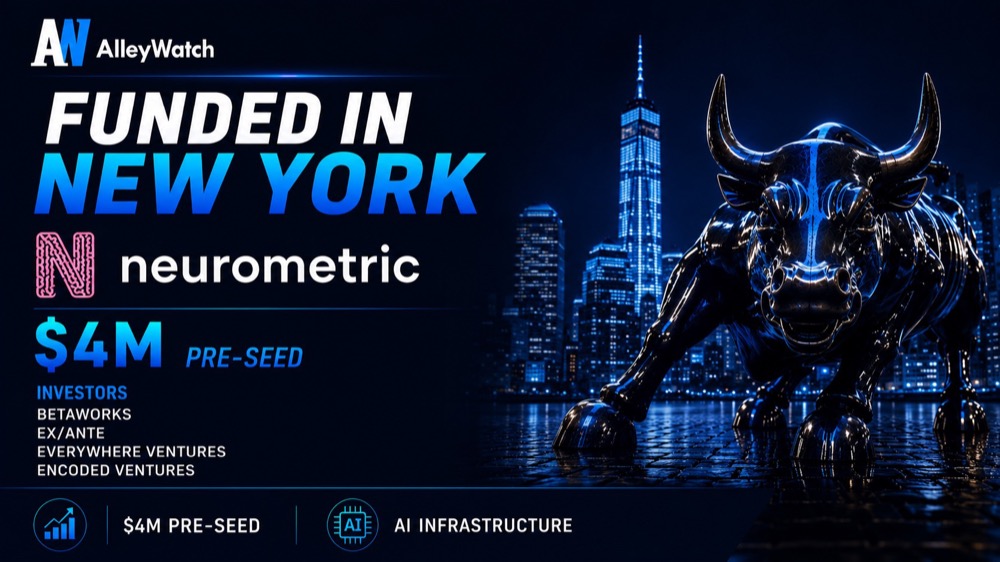
We raised a $4M pre-seed round earlier this spring from Betaworks, ex/ante, Everywhere Ventures, Encoded Ventures, Vermillion, Abstraction, and Mu Ventures, along with angel investors like Jason Calacanis and Dharmesh Shah, CTO of HubSpot. After closing the round, the team stayed focused on developing and testing the platform with customers, and once the product was ready to launch, it felt like the right moment to bring both announcements together.
Tell us about the product or service that Neurometric offers.
Neurometric is an automated token engineering platform built for companies running agentic AI workloads at scale. The core idea is that every single AI model call inside a workflow is also a pricing decision, and most companies are making that decision badly because they default every task to expensive frontier models regardless of what the task actually requires. Our platform brings three things together to fix that. A Task Endpoint Manager automatically evaluates every request and routes it to the most cost-effective model that still meets the accuracy, speed, and quality bar that task needs. An SLM Marketplace gives customers instant access to pre-trained models already built for common, recurring workloads. And when nothing on the market hits the right combination of cost and quality, our Auto-SLM Creator generates a purpose-built small language model trained specifically for that task. You end up with a system that constantly matches the right model to the right job instead of a static setup that gets more expensive and less efficient as your workflows scale.
What inspired the start of Neurometric?
 I kept running into the same pattern across nearly every company building agentic systems. They would start with a frontier model because it is the fastest way to get something working. The problem is that nobody revisited it once the system moved into production, and a single agent can fire off dozens of sequential model calls to complete one task. Every one of those calls was getting billed at frontier rates, even the simple ones, which I like to compare to hiring someone with three PhDs to work a cash register. I spent years in inference optimization and chip design before that, so I understood the underlying economics of why this was happening and how badly most teams were managing it. We started Neurometric because the market needed something that could make that decision automatically and continuously rather than relying on engineers to manually re-architect their model routing every time pricing or performance shifted.
How is Neurometric different?
Most companies doing SLM model routing today are doing so manually, with point solutions or one-off engineering projects that go stale because the model market moves so fast. A routing decision that made sense three months ago might be the wrong one today because a new model dropped or pricing changed. Neurometric automates the entire process as a continuous, self-correcting loop instead of a one-time setup. Customers can pull from our SLM Marketplace when an existing model already fits, or get a custom one built automatically when nothing does, all within the same platform. Customers keep capturing savings as the market shifts rather than having to manually re-tune their architecture every quarter, which is the trap most engineering teams fall into.
What market does Neurometric target and how big is it?
We work with companies running agentic AI workloads at meaningful production scale, and that spans a wide range of industries at this point, from healthcare and financial services to logistics, insurance, and customer support. The thing that connects all of them is that they have moved past the experimentation phase and are now running workflows where model calls compound quickly, and the AI spend has become one of the largest and least-managed line items in their technology budget. As more companies push agents from pilots into production this year, that surface area only grows, because every additional agentic workflow is another set of model calls that need to be optimized rather than left running on autopilot at frontier pricing.
What’s your business model?
We have a usage based model for the SLMs we create for customers, and then a core platform fee for the management endpoint tool that provides analytics and information.
How are you preparing for a potential economic slowdown?
Our entire product exists to help companies spend less on AI without sacrificing performance, so in a strange way a slowdown is the environment where this becomes more valuable for companies. When budgets tighten, the companies still routing every task through the most expensive model available are going to be the first ones forced into painful, blunt cuts, like turning off AI features entirely or pulling back on adoption. We let companies make those cuts intelligently instead, by routing work to cheaper or purpose-built models where it makes sense and reserving frontier spend for the tasks that genuinely require it.
What was the funding process like?
It’s a painful market out there because AI is changing so fast, investors don’t know what to back. But we have an extremely senior team and this is my 5th startup and so, maybe it was a little easier than the average fundraise. It still took longer than expected.
What are the biggest challenges that you faced while raising capital?
Token engineering is new enough as a category that a lot of our early investor conversations were spent just establishing the problem before we could even get to our solution. People understood that AI was expensive, but a lot of investors initially assumed the fix was simply switching everything to a cheaper model, rather than understanding that the real opportunity is continuously and automatically matching every individual task to the right model as the market itself keeps shifting underneath you. Once that distinction landed, the rest of the conversation got much easier, but getting there sometimes took a full meeting.
What factors about your business led your investors to write the check?
I think it came down to two things. First, the team has a combination of AI research depth and systems engineering experience that is genuinely rare this early in a company’s life, and investors picked up on that quickly. Second, we had real proof points instead of just a thesis. One customer moved a core workflow from $40,000 a year down to $250 a month while improving accuracy from 70 percent to 96 percent, and that kind of result is hard to argue with once you see it.
What are the milestones you plan to achieve in the next six months?
We are using this funding to expand our engineering and AI research teams so we can give customers even more optimization tools as part of the core platform. The model market is moving so fast that staying ahead of it requires real investment in research, not just engineering headcount, so a meaningful part of this is building out the team that can keep our routing and evaluation systems current as new models enter the market every few weeks.
We are using this funding to expand our engineering and AI research teams so we can give customers even more optimization tools as part of the core platform. The model market is moving so fast that staying ahead of it requires real investment in research, not just engineering headcount, so a meaningful part of this is building out the team that can keep our routing and evaluation systems current as new models enter the market every few weeks.
What advice can you offer companies in New York that do not have a fresh injection of capital in the bank?
Focus relentlessly on the one problem you solve better than anyone else, and make sure you can prove that with real numbers from real customers rather than a narrative. Capital makes things move faster once you have that proof, but it does not replace it, and trying to raise before you have a clear and defensible reason for existing usually just wastes time you do not have. I would also say do not be afraid to sit on good news, like we did with this raise, if waiting means you can tell a stronger story when you finally do share it.
Where do you see the company going now over the near term?
Token engineering is still treated as a manual, specialized task today, something a handful of sophisticated engineering teams figure out for themselves while everyone else just eats the cost. We think it eventually becomes infrastructure that every company running AI agents simply has, the same way nobody thinks twice about using a CDN or a load balancer anymore. Getting there means continuing to make the platform smarter and more automated, so that the decision of which model handles which task becomes invisible to the people building on top of it.
What’s your favorite summer destination in and around the city?
You can find me regularly sipping bourbon and listening to live music at The Flatiron Room.